Showing posts with label Grand Tactics. Show all posts

Monday, January 26, 2015

The Four Big Books

Asking for information on Linear Warfare and Grand Tactics in the 18th Century (the "Flintlock Musket and Socket Bayonet Era"), I've had four books recommended to me, again and again. This is a list of those four books, blog-style.

I'm not going to list them chronologically, I'm listing them in the order that I'm reading them this year, 2015. I think it's a useful order, and anyway it's working for me.

Nosworthy, Brent. (The) Anatomy of Victory: Battle Tactics 1689 - 1763. New York: Hippocrene, 1990

This is the basic book for understanding units, formations, distances, frontages, strategies, tactics, linear warfare, grand tactics, theory, practice, etc. What formations did the troops take and how did they maneuver in those formations? How practical were various formations and what were the typical elements and their battlefield missions? This is the book which opened up the understanding of 18th Century deployment and maneuver for me.

There should be a Wikipedia page for Brent Nosworthy and for Anatomy of Victory, for the amount of times the book can be cited to clarify specifics as to formations and tactics. I should fix that.


Out of print. Pricey, but essential. Wait for a sale.

Duffy, Christopher. The Military Life of Frederick the Great. New York: Atheneum, 1985.

This is the book for understanding the campaign and the battle, linear warfare as it was actually practiced, the operational strategy of the period, and some of the key personalities and forces of the era. Christopher Duffy has written extensively on the era, and this book is considered a classic tome. I'm finding it a fascinating read as well. Duffy knows his material and his sources well, and weaves a tale of a man destined to a duty almost beyond him, a strange and enigmatic figure of an ancient sort of martial nobility. I have a copy from the public library. It's on the Short List of Books to Buy.

Probably also OOP, and pricey. Equally essential.

Showalter, Dennis. Frederick the Great: A Military History. London(?): Frontline, 2012.

This is also one of the most highly-recommended books, and it will be nice to get an updated view of Duffy's 1985 book. I just got this from the library (through ILL), and I'll read it right after I finish the SYW chapter in TMLoFtG. I only have it for a month, but this book is also on the Short List.
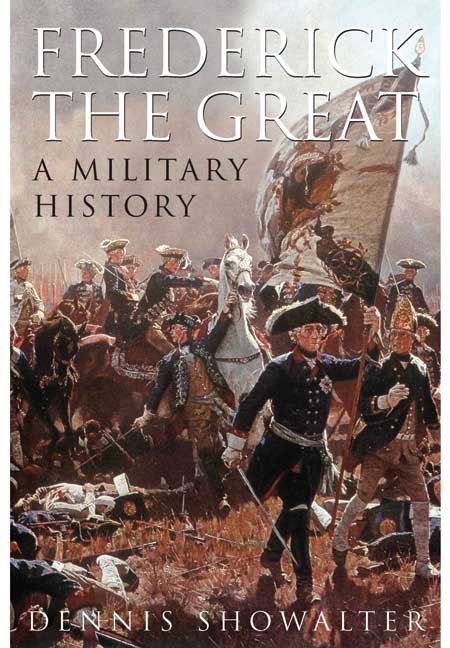
Recent, available and reasonable? And what a dust jacket! I finally get the reference!


Duffy, Cristopher. The Military Experience in the Age of Reason. London: Routledge, 1987.

After reading two accounts of the campaigns of Frederick the Great, I think it'll be good to also read about the daily lives of the soldiers, troopers and commanders who fought these wars, to truly understand the nature of the period and the conflict. I'll read this last. Acquired.

Available at a reasonable price in trade.

And those, Gentle Readers are the Four Big Books that I'll be reading in 2015.

Progress thus far? I've read in AoV right up through the start of the SYW, and I've read in TMLoFtG up to the end of the SYW chapter, now I'll read FtG: AMH entirely, then I'll finish AoV, then I'll finish TMLoFtG, then I'll read TMEitAoR, which I had just barely started when all of these other books arrived.

Reviews and impressions to follow. And thanks to those who recommended these books.


Monday, January 19, 2015

Give Battle: A Study of Linear Warfare & Grand Tactics

The Welcome Address

Welcome, Gentle Friends, to Give Battle! A Study of Linear Warfare & Grand Tactics.

Q: What is it?

A: It's a blog for me, by me, where I can record and attempt to organize some of the volumes of information I've learned about 18th Century Linear Warfare, Grand Tactics, Operational Strategy and The Cost of Campaigning.

Q: Why a blog?

A: Because blogs are bright and colorful and can be inspiring.

Also, I think tagging might help.

Q: Why "Give Battle!" as a name?

A: Because war gaming is often battle gaming, and when we read histories of wars, they're generally written as histories of campaigns, made up of a series of battles, (or possibly commanders who sought to evade or harass their opponents, and refused to give battle).

In any case, the field commander needs to know how certain formations performed under actual battlefield conditions, and how practice compared to theory, and therefore battles become our chief concern.

Q: Why the concentration on the Seven Years War?

A: The period of the Seven Years War is often considered the culmination of the period of linear warfare (and grand tactics of the Frederician school), and it also lies very much in the middle of the flintlock musket and socket bayonet era.

It falls between the earlier, "Marlburian" school of multiple lines of attack (like, say 4 lines at Blenheim - the Baroque), and the later "Napoleonic" school of attack columns and "revolutionary" impulse formations (the Romantic).

It's also considered the "Last Argument of Kings" or the end of the era of the Ancien Régime, the last big war purely prosecuted for "dynastic" reasons (before the revolutionary and nationalist eras).

It's the Rococo period in the Age of Reason, when philosopher-kings strode about the land with their small corps and Royal Armies and kicked giants in the knee. The actual details are even more interesting than the legend.

Q: What next?

A: See list:

A list (of course) of the applicable Osprey titles (with pictures of the covers, arranged by series).

A list (as well) of some of the well-known artists who've chosen the period (with lots of pictures, and the occasional war gamer quibble about the veracity of the pose or the equipment).

A couple of pages of dimensions, with discussions of formations, frontages, unit depth, space per soldier/trooper and the like.

A couple of pages with organizational information, how many platoons to a company, or troops to the squadron, leaders, support, supply and things of that nature.

Some discussion of campaigning, from an operational point of view. Some discussion of the basics of military missions, infantry operations, cavalry operations, artillery operations, siege operations, bridge-building, encampment, fortification and et cetera.

Some discussion of the particulars of the soldier's personal equipment and weapons, as well as those of his unit and his army.

A very general discussion of the uniforms of the era, with reference to current fashion and practice, as well as the utility of said garments for the intended military purpose.

Ditto grooming, queues, wigs, powder, drawing a mustache on one's face, tall guys in the front rank and other such relevant minutiae of the soldier's life.

A list of the "recommended" books to read on the subject, about the key commanders, their military careers, campaigning in the 18th Century, and the specifics of Linear Warfare and Grand Tactics, from the point of view of the occasional war gamer and Armchair Field Marshal.

A list of the horse-and-musket rulesets that I happen to own or have access to, and later on, some reviews of said rulesets, complete with my own personal attempts to distill an "ultimate set" of House Rules for the Solo Campaign.

Possibly, a list of some recommended listening to accompany the study of the era and the science of the campaign.

Q: Updated often?

A: There are other things in life, better sources for the information and many beautiful blogs which already cover the information in much greater detail.

When I find a factoid I want to write down and access later, hopefully I'll remember to post it here and tag it properly.

Q: What's up with the moustaches?

A: I'm really not sure. We'll see what further research reveals.

Q: What happened to those other blogs?

A: Ooh Shiny!

(Small unit tactics led me to the origin of small unit tactics led me to grand tactics led me to linear warfare led me to operational strategy led me to campaign management... Ooh Shiny!)

So, Welcome, Fellow Gamers, Fellow Scholars, Fellow Historians, Fellow Art Lovers.

Thanks for reading, and I hope you find it useful.