Showing posts with label Frederick the Great. Show all posts

Monday, January 26, 2015

The Four Big Books

Asking for information on Linear Warfare and Grand Tactics in the 18th Century (the "Flintlock Musket and Socket Bayonet Era"), I've had four books recommended to me, again and again. This is a list of those four books, blog-style.

I'm not going to list them chronologically, I'm listing them in the order that I'm reading them this year, 2015. I think it's a useful order, and anyway it's working for me.

Nosworthy, Brent. (The) Anatomy of Victory: Battle Tactics 1689 - 1763. New York: Hippocrene, 1990

This is the basic book for understanding units, formations, distances, frontages, strategies, tactics, linear warfare, grand tactics, theory, practice, etc. What formations did the troops take and how did they maneuver in those formations? How practical were various formations and what were the typical elements and their battlefield missions? This is the book which opened up the understanding of 18th Century deployment and maneuver for me.

There should be a Wikipedia page for Brent Nosworthy and for Anatomy of Victory, for the amount of times the book can be cited to clarify specifics as to formations and tactics. I should fix that.


Out of print. Pricey, but essential. Wait for a sale.

Duffy, Christopher. The Military Life of Frederick the Great. New York: Atheneum, 1985.

This is the book for understanding the campaign and the battle, linear warfare as it was actually practiced, the operational strategy of the period, and some of the key personalities and forces of the era. Christopher Duffy has written extensively on the era, and this book is considered a classic tome. I'm finding it a fascinating read as well. Duffy knows his material and his sources well, and weaves a tale of a man destined to a duty almost beyond him, a strange and enigmatic figure of an ancient sort of martial nobility. I have a copy from the public library. It's on the Short List of Books to Buy.

Probably also OOP, and pricey. Equally essential.

Showalter, Dennis. Frederick the Great: A Military History. London(?): Frontline, 2012.

This is also one of the most highly-recommended books, and it will be nice to get an updated view of Duffy's 1985 book. I just got this from the library (through ILL), and I'll read it right after I finish the SYW chapter in TMLoFtG. I only have it for a month, but this book is also on the Short List.
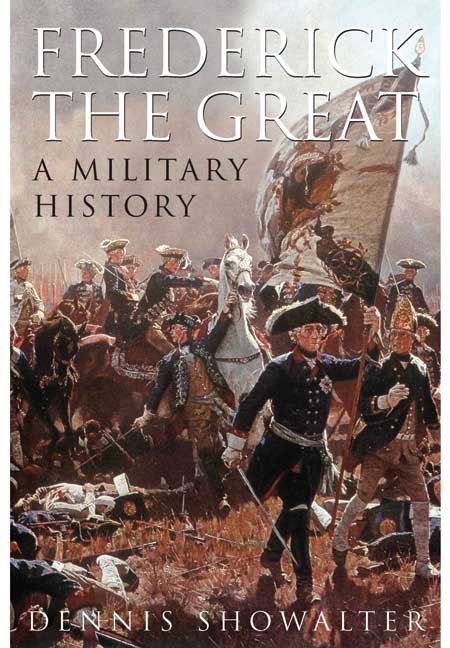
Recent, available and reasonable? And what a dust jacket! I finally get the reference!


Duffy, Cristopher. The Military Experience in the Age of Reason. London: Routledge, 1987.

After reading two accounts of the campaigns of Frederick the Great, I think it'll be good to also read about the daily lives of the soldiers, troopers and commanders who fought these wars, to truly understand the nature of the period and the conflict. I'll read this last. Acquired.

Available at a reasonable price in trade.

And those, Gentle Readers are the Four Big Books that I'll be reading in 2015.

Progress thus far? I've read in AoV right up through the start of the SYW, and I've read in TMLoFtG up to the end of the SYW chapter, now I'll read FtG: AMH entirely, then I'll finish AoV, then I'll finish TMLoFtG, then I'll read TMEitAoR, which I had just barely started when all of these other books arrived.

Reviews and impressions to follow. And thanks to those who recommended these books.


Recommended Listening

The Kind of Thing Fit for a King
(Thank You, Public Library)

Individual reviews may follow, but all of these are recommended.

Albinoni Oboe Concertos Chandos

From the Court of Frederick the Great Sony

Bach Complete Flute Sonatas (2 CD) Hyperion

Elevazione Gordon Hunt BIS-NL

Bach for Meditation Naxos

Monday, January 19, 2015

The Short List of Big Books

I'm reading some of the "classic" recommended books on these subjects, the ones written like textbooks, with annotation and attribution. There is a sort of Short List of Necessary Titles, to which one may add the Longer List of Useful Additions, if one so desires.

On this page, we'll start with the Nosworthy and the Duffy and the Showalter, and proceed to the Szabo and Anderson, the Warnery and the Catt, the General Staff and the Military Archives.

This was a list for me, a rank beginner, interested chiefly in the tactics and operations of the forces on the ground from the perspective of the campaigning army commander, as recommended to me by other hobbyist war gamers from their experience for much the same reasons, viz, unit frontage and effective action range, per unit time, as might be experienced in a game turn. Use accordingly.

Osprey titles have their own page, as do works of a more scenic nature. This page is for textbooks.

List to follow, as always. This is a stub. Maybe a stem. Definitely a start.

Cheers.

Recommended Listening

I Like Bach.

There. I said it. I'm glad we got that out of the way.

I Like Baroque.

That, also, felt really good.

Now that you know that about me, let me also say that harpsichords (especially digital recordings of harpsichords) can be really grating.

I Like Cello, Violin if it's not too grating, Oboe because it is haunting, Flute if played on a period instrument or in a period style or exploring previously unexplored work. I don't mind the occasional Cembalo, I don't mind a bit of Lute, I actually enjoy Clavinet, and Horns have their place, as well. Organ should be used with restraint.

I personally do not listen to a lot of Vocal Music, except in some very specific styles.

I don't mind the Presto and the Allegro, but I prefer the Largo and the Siciliano.

What follows will be a list of some composers, some notable works, some specific performances, perhaps a video link or two, and possibly some CD reviews.

In the interest of full disclosure, let me add that I have both a "CPE Bach" station and a "Frederick the Great" station on my Pandora.

Music can be quite revealing of character, and the fact that Frederick the Great liked the sound of the oboe, the fact that the oboe had a place in military music, the fact that the Prussians used their martial musicians to improve cadence and the fact that Frederick was an "accomplished amateur" philosopher-king flute player and composer all converge to make Baroque music quite meaningful for me in this context, particularly the melancholy sounds of the oboe, the gravity of the cello, the hopefulness of the flute, the wail of the violin or viola, and the blare of the horn.

Listen to some Baroque. Listen to the beautiful, emotional, lovely clockwork and airy constructions of Bach, his contemporaries, his sons, their contemporaries, and the Baroque to Rococo to Classical transition and tradition that they encompass.

Here's a nice place to start: