Showing posts with label Campaign. Show all posts

Monday, January 26, 2015

The Four Big Books

Asking for information on Linear Warfare and Grand Tactics in the 18th Century (the "Flintlock Musket and Socket Bayonet Era"), I've had four books recommended to me, again and again. This is a list of those four books, blog-style.

I'm not going to list them chronologically, I'm listing them in the order that I'm reading them this year, 2015. I think it's a useful order, and anyway it's working for me.

Nosworthy, Brent. (The) Anatomy of Victory: Battle Tactics 1689 - 1763. New York: Hippocrene, 1990

This is the basic book for understanding units, formations, distances, frontages, strategies, tactics, linear warfare, grand tactics, theory, practice, etc. What formations did the troops take and how did they maneuver in those formations? How practical were various formations and what were the typical elements and their battlefield missions? This is the book which opened up the understanding of 18th Century deployment and maneuver for me.

There should be a Wikipedia page for Brent Nosworthy and for Anatomy of Victory, for the amount of times the book can be cited to clarify specifics as to formations and tactics. I should fix that.


Out of print. Pricey, but essential. Wait for a sale.

Duffy, Christopher. The Military Life of Frederick the Great. New York: Atheneum, 1985.

This is the book for understanding the campaign and the battle, linear warfare as it was actually practiced, the operational strategy of the period, and some of the key personalities and forces of the era. Christopher Duffy has written extensively on the era, and this book is considered a classic tome. I'm finding it a fascinating read as well. Duffy knows his material and his sources well, and weaves a tale of a man destined to a duty almost beyond him, a strange and enigmatic figure of an ancient sort of martial nobility. I have a copy from the public library. It's on the Short List of Books to Buy.

Probably also OOP, and pricey. Equally essential.

Showalter, Dennis. Frederick the Great: A Military History. London(?): Frontline, 2012.

This is also one of the most highly-recommended books, and it will be nice to get an updated view of Duffy's 1985 book. I just got this from the library (through ILL), and I'll read it right after I finish the SYW chapter in TMLoFtG. I only have it for a month, but this book is also on the Short List.
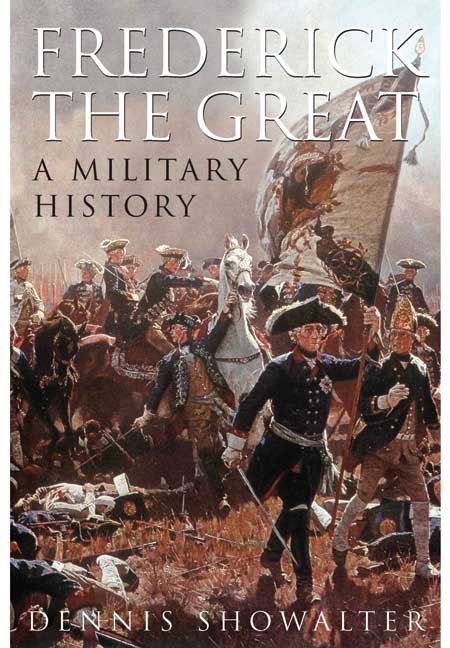
Recent, available and reasonable? And what a dust jacket! I finally get the reference!


Duffy, Cristopher. The Military Experience in the Age of Reason. London: Routledge, 1987.

After reading two accounts of the campaigns of Frederick the Great, I think it'll be good to also read about the daily lives of the soldiers, troopers and commanders who fought these wars, to truly understand the nature of the period and the conflict. I'll read this last. Acquired.

Available at a reasonable price in trade.

And those, Gentle Readers are the Four Big Books that I'll be reading in 2015.

Progress thus far? I've read in AoV right up through the start of the SYW, and I've read in TMLoFtG up to the end of the SYW chapter, now I'll read FtG: AMH entirely, then I'll finish AoV, then I'll finish TMLoFtG, then I'll read TMEitAoR, which I had just barely started when all of these other books arrived.

Reviews and impressions to follow. And thanks to those who recommended these books.


Monday, January 19, 2015

European SYW Osprey Campaign Titles

Right now I'm reading the fabulous The Military Life of Frederick the Great, by the wonderful Christopher Duffy. As an adjunct to that book, I'm also reading the three Osprey Campaign titles that deal with a few of the European campaigns of the Seven Years War, specifically the movements of Frederick the Great during the early years of the war.

After I read the relevant section of Duffy's book, I set it aside for a day and read one of Simon Millar's three books: Kolin 1757, Rossbach and Leuthen 1757, and Zorndorf 1758. The books are Osprey Campaign Series Numbers 91, 113 and 125, respectively.

We'll discuss these particular battles, and the tactics involved, in a separate post, but for now I'd like to discuss the Osprey books themselves. I find them quite useful, especially as a starting point for further research. I got all three titles through the Inter-Library Loan system, so I only have them for a brief time, but I would consider buying all three.

What I Liked:

1) These books are a pretty easy read. If I skip the illustrations and the captions, I can breeze through the main text in about four hours. When I go back and read the captions and the maps, it's another summary of the text, in a more visual format. That helps with the retention.

2) They have very nice full-color two-page spreads, of action scenes from the battle, complete with numbers and captions on the overleaf, detailing the finer points of the research. They are all done by Adam Hook, who does a fine job conveying a sense of the scale, the setting and the mood of the action. There are three such "double-spreads" in each of the volumes, and all are well in the tradition of Osprey action tableau.

3) The campaign maps are reasonably close to the relevant text, are fairly well colored, and very nicely drawn showing the terrain and major towns of the wider theaters as well as the local areas near the final battle sites. The text on the legend is tiny, and the pages are shiny. I recommend daylight for the maps and the illustrations, while text can be done by electric light. More on that with the Cons.

4) They're short, they're colorful, they're focused on one (or two) battle(s) and the surrounding campaign, they give just enough information on a few of the leaders and a few of the units and the overall flavor of the period to really serve to induce the reader to wider research, and they provide a nice bibliography of the "accepted" "recommended" generally English-language sources, with enough prints after the "well known" "expert" artists. In short, I would say worth the 20 bucks.

Glitches That Are Really Features:

1) As above, reading the text is easy on the eyes. Once through for the narrative, then again by daylight for the illos helped my old eyes, and hopefully helped my muddled memory.

2) The art that isn't part of the big spreads can be... small... black and white... a print... probably fairly common, once you do the research... somewhat muddy... underwhelming by electric light. Again, a second read-through in full daylight does the trick.

3) We've spoken about the campaign maps, what about the "3D" "bird's-eye view" maps, and the regular battle maps? Well, here's the rub about the illos and maps reading separately from the text.

Battle maps work best for me when I flip back and forth, from the maps to the narrative, from the narrative back to the map. In a big book like the Duffy book, there are less maps per battle, because each is trying to contain the whole day in one or two maps.

Here there are six or eight maps per battle (something like three of the birds-eye and three of the standard style per major battle). So while I'm trying to read the narrative, I'm also looking for the correct unit on the correct map, without trying to get distracted by the beauty of the map itself, and all that tiny, tiny text detailing the day by the half-hour.

Again, going back the next day, and just poring over the maps, in and of themselves, in a nice bright light relieves my anxiety that I am somehow missing important details of the story and affected units.

4) There are those who consider Osprey books to be Cliff Notes for wargamers, and I suppose they may be right, but I don't find that to be such a bad thing. These three copies have to go back to the library, but the titles get added to the Longer List of Additional Material, as well as the Relevant Osprey list.

Really, for anyone interested in Linear Warfare and Grand Tactics in the 18th Century, and is looking for useful diagrams of units in formation and the movements of those units over the course of a campaign and throughout a day of battle, these are very useful volumes, and I look forward to adding them to the collection and reading them again.

Also, they make a nice summation of the state of the Prussian army at the start of the war, throughout the first couple of years, and of their abilities to perform some of the more complicated maneuvers required by their commander, the always interesting and often innovative Frederick the Great.


Prussian and Austrian cavalry meet at Leuthen.

The Relevant Osprey Titles

As always, when I want to study a certain era, I begin with a reading list. One immediate list is always the relevant Osprey titles. From there one can usually find some good leads on a bibliography for the subject.

It also pays to ask on a useful website, if others can recommend useful books on the subject. Later, a listing of some of the more academic titles. Herewith, for now, some of the relevant Osprey titles.

Pictures of the covers, for reference, to follow. Cheers.


Prussia:


MAA16

FtG's Army (old)


MAA236, 240, 248

FtG's Army 1, 2, 3


MAA460

FtG's Allies


Austria:


MAA6

Austro-Hungarian Army of the SYW (old)


MAA271, 276, 289

Austrian Army 40-80 1, 2, 3


MAA413

Austrian Frontier 40-98


WAR81

Hungarian Hussar 56-15


Russia:


MAA297, 298

Russian Army of the SYW 1, 2


France (European Theater):


MAA296, 302, 304

Louis XV's Army 1, 2, 3


Britain (European Theater):


MAA285, 289, 292

King George's Army 40-93 1, 2, 3


MAA261
18th-Century Highlanders


Campaigns and Battles:


Campaign 91
Kolin 1757


Campaign 113
Rossbach and Leuthen 1757


Campaign 125
Zorndorf 1757